como estragar um bom filme em menos de 5 minutos! o.O
imagine-se um belo filme coreano, onde o cenário, a cor, a fotografia, a música, os personagens, a gestão incrível dos silêncios... tudo está a correr bem. o desenrolar da estória, o crescimento dos personagens, as situações, os ambientes, tudo no sítio certo, harmonioso... lindo! mais uma vez, kim ki duk consegue coerência e envolvimento na estória sem que os protagonistas digam uma palavra em voz alta (apenas sussurram ao ouvido).
de repente, no que se vê bem ser a finalização da trama, vemos deitada no chão de um barco, vestida no branco imaculado da sua roupa interior, a lindíssima adolescente coreana, recém casada com o velho que a acolheu e criou, num barco, de onde nunca saiu, desde os 6 anos de idade, . tinha adormecido ao som da música tocada pelo velho, antes mesmo de se unirem como marido e mulher, pela primeira vez. ele atira-se à água, desaparece e o barco vagueia, sozinho... e a rapariga dorme.
e é aqui que deveríamos ter tido vontade de ir à casa de banho, um ataque de cegueira temporária, algo que não nos deixasse ver ... quando a rapariga ainda adormecida começa a afastar as pernas ficamos logo com a sensação que algo vai correr mal... e corre mesmo!! o problema não está no conceito do fantasma do marido que desflora a sua jovem noiva, não! o problema está na maneira como foi feito. os gemidos, a expressão, o jovem estudante que a abraça entretanto e, a seta que aparece do nada... e o sangue que mancha o vestido imaculado... isso já é demais!! e é pena, porque o filme estava a saber mesmo bem.

mas de qualquer forma, vale a pena ver. saír uns minutos antes do fim pode ser uma boa opção ;)





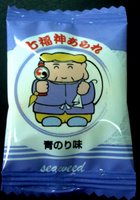 a mim calhou-me o Daikokuten (大黒天) que, de acordo com a folha explicativa que nos entregou, é o deus da cozinha, que tem um maço da sorte na mão e carrega um saco de arroz nas costas. que raio! da cozinha??? humpf! então fui investigar... e foi isto que descobri:
 takarabune (宝船), which is an auspicious symbol, especially found during New Year celebrations. The seven deities have independant origins in Buddhism, Taoism and Shinto. Although the impetus for the grouping is uncertain, these seven auspicious deities are first believed to have been grouped together and given the name Shichifuku during the Muromachi period.
  Daikokuten is generally famous as a god of luck. He is most familiar in Japan as a fat, smiling figure with a big sack over his left shoulder and a mallet in his right hand, standing on bales (tawara 俵) full of rice. He was particularly popular in the Edo period as one of the Shichifukujin. However, in India he was a warrior deity called Mahakala and was considered an emanation of Siva. In texts his name was transliterated as Makakara and translated as Daikokuten in the DAIHOUTOUDAIJITSUKYOU, translated in the Zui dynasty. It appears that Daikokuten came to be a protector of food supply because images of him were placed in monastery kitchens in India and in China. In Japan this practice is said to have been begun by Saichou on Mt. Hiei. The oldest extant image of Daikokuten in Japan is the late Heian wooden sculpture in Kanzeonji in Dazaifu (Fukuoka prefecture) In this, his expression is fierce. In the sculpture of Myoujuin of Kongourinji (Shiga prefecture; late Heian) he is shown in armor. Thus, his identity as a war god is still apparent. Later he became more closely associated with food and good forture. This tendancy was reinforced by his identification with the Shinto deity Ookuninushino Mikoto. He is variously considered to be the god of wealth (or more specifically, the harvest), or of the household (particularly the kitchen). He is recognised by his wide face, smile, and flat black hat. He is often portrayed holding a golden mallet, seated on bales of rice, with mice nearby (Mice signify plentiful food).












 lomo
lomo


